Hazard Identification Risk Assessment Control
HIRAC Training
WELCOME TO SJLM CONTRACTING
HIRAC GOAL
For all SJLM Contracting employees to understand and be comfortable in conducting the Hazard Identification & Risk Assessment Control (HIRAC) process and have an understanding of the content that is required.
DEFINITIONS
Hazard: The potential to cause harm to a person or to the natural environment.
Event: An occurrence of a particular set of circumstances. An event can be a single occurrence or a series of occurrences.
Hazard / Risk Management: The structured process of hazard identification, risk assessment and control aimed at providing a safe and healthy environment for workers, contractors, clients and visitors whilst on a SJLM project site.
Risk: A combination of the likelihood and consequence of harm arising from a hazard.
Risk assessment: The process of evaluating likely frequency and consequence of harm arising from a hazard.
Risk control: The process of implementing measures to reduce as far as reasonably practicable the risk associated with a hazard. The control process must follow the hierarchy of control, in order, as prescribed in health and safety legislation.
Initial Risk: Is the risk of the event before any controls have been put in place.
Residual Risk: Is the remaining risk of the event after controls have been put in place.
ALARP: (As Low As Reasonably Practical) – once risk controls have been implemented, it is important to make sure that the remaining residual risk is acceptable and as los as reasonably practical.
Severity: The elvel of impact of an event i.e. exposure to a hazrad measured in terms of harm.
Likelihood: The probability or frequency of the event.
NOTE: It is important that control measures do not introduce new hazards, and that the ongoing effectiveness of the controls is monitored.
WHAT IS YOUR RESPONSIBILITY
WHS Act 2012
Duty of persons conducting businesses or undertakings involving management or control of workplaces (S20 Act)
The person with management or control of a workplace must ensure, so far as is reasonably practicable, that the workplace, the means of entering and exiting the workplace and anything arising from the workplace are without risks to the health and safety of any person.
Persons conducting a business or undertaking will have health and safety duties to manage risks if they:
engage workers to undertake work for them
they direct or influence work carried out by workers
may put other people at risk from the conduct of their business or undertaking
manage or control the workplace or fixtures, fittings or plant at the workplace
design, manufacture, import or supply plant, substances or structures for use at a workplace
install, construct or commission plant or structures at a workplace.
Management of risks (S17 Act)
A duty imposed on a person to ensure health and safety requires the person
(a) to eliminate risks to health and safety, so far as is reasonably practicable; and
(b) if it is not reasonably practicable to eliminate risks to health and safety, to minimise those risks so far as is reasonably practicable.
Primary Duty of Care (S19 Act)
(1) A person conducting a business or undertaking must ensure, so far as is reasonably practicable, the health and safety of—
(a) workers engaged, or caused to be engaged by the person; and
(b) workers whose activities in carrying out work are influenced or directed by the person; while the workers are at work in the business or undertaking.
Duty of officers (S27 Act)
Officers (for example company directors) must exercise due diligence; this includes taking reasonable steps to:
gain an understanding of the hazards and risks associated with the operations of the business or undertaking
ensure that the business or undertaking has and uses appropriate resources and processes to eliminate or minimise risks to health and safety.
The requirements for HIRAC are outlined in SJLM’s OHS-SP-01 Risk assessment procedure.
Hazard
The potential to cause harm to a person or to the natural environment.
A hazard is any situation, substance, activity, event, or environment that could potentially cause injury or illness.
Example: Working at heights, Working with hazardous chemicals or substances, Working around water, poor lit areas, confined space work, noisy location, flammable and explosive materials, radioactive substances, heavy lifting or manual tasks;
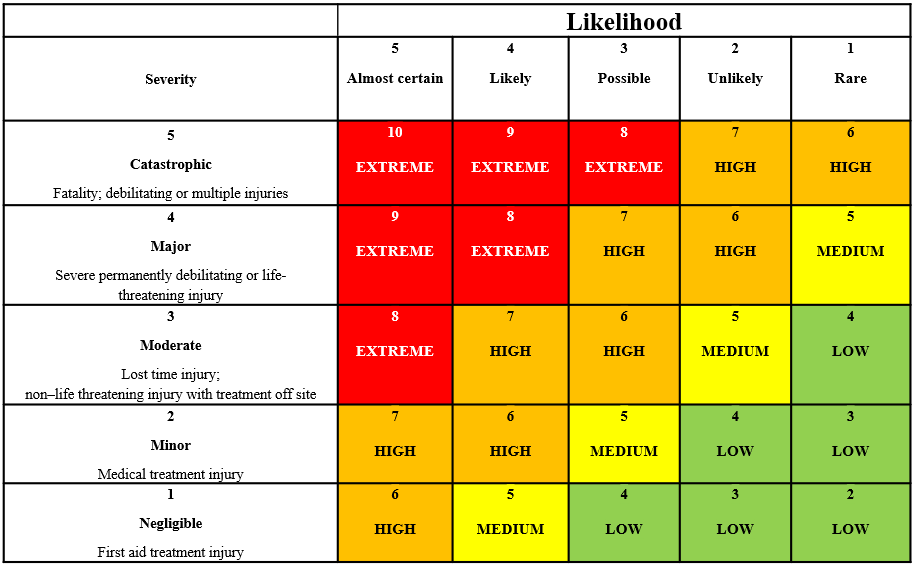
CONSEQUENCE
Consequence of an Incident
Determining Consequence
Determining Likelihood
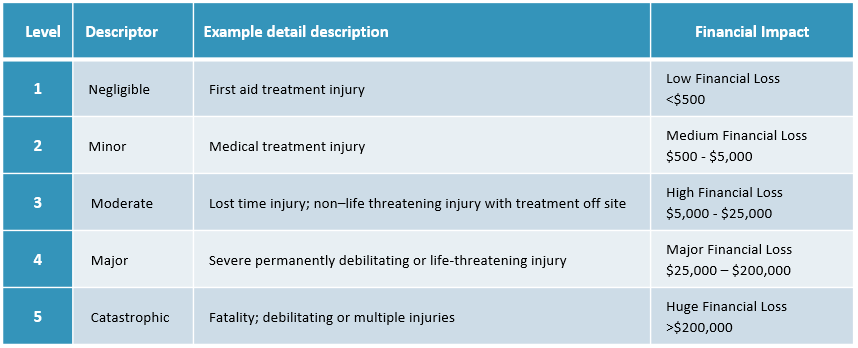
CONSEQUENCE OF AN INCIDENT
Severity of Consequence:
Injury level as the consequence of an incident
DETERMINING CONSEQUENCE
To determine consequence, you need to consider the following:
How bad a potential incident might be
Which part of the body is exposed to the injury
Type of event e.g. explosion, fall etc.
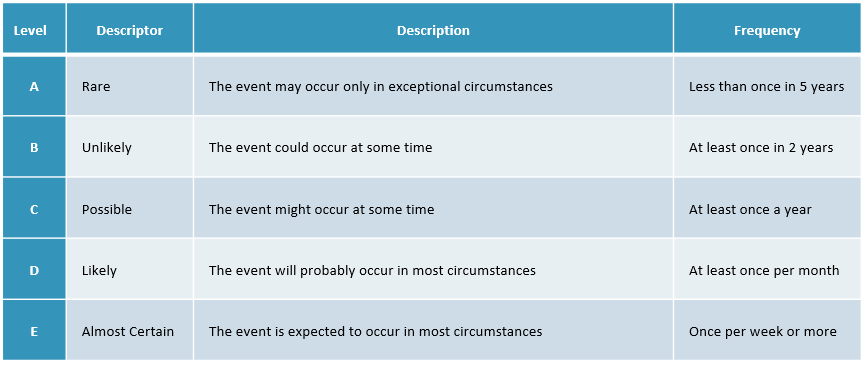
DETERMINING LIKELIHOOD
To determine value of likelihood, consider the following:
A: Unsafe Action. Related to human behaviour.
Examples:
incompetent person commencing work
personnel ignoring safety procedures- workers not using proper PPE
how regularly the activity is being performed
Unsafe Condition. Related to equipment, site conditions, weather, etc.
Examples:
deep excavation with no barricadeØscaffolding without safety railings
leakage on hydraulic hoses on heavy equipment
poor housekeeping
Main Thing to consider:
How likely is it that an incident will occur considering the controls in place
RISK
Risk is combination of consequence of an incident and likelihood of that event occurring.
(Risk = Consequence x Likelihood)
Risk Assessment
A risk assessment considers the effectiveness of existing WHS controls and then evaluates the probability and the severity of specific hazardous events and exposures.
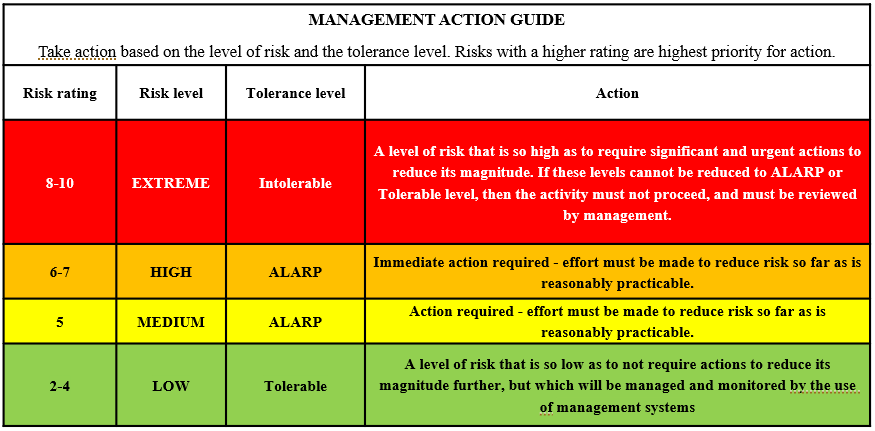
RISK CLASSIFICATION
ACCEPTABLE RISK
Risk that has been reduced to a level that can be tolerated by SJLM having regard to legal obligations and its own WHS Standards
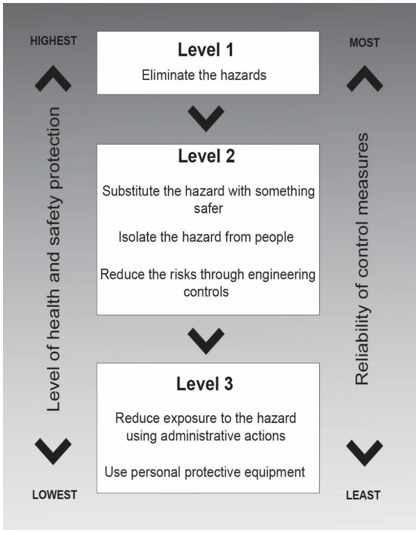
HIERARCHY OF CONTROL
Highest to lowest
Most effective to least effective
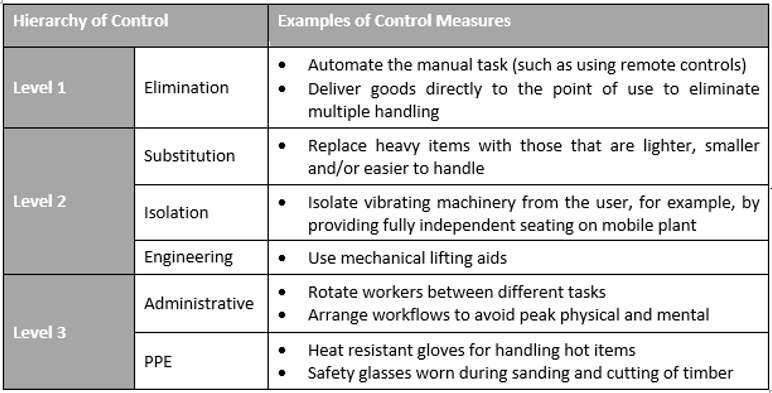
HIERARCHY OF CONTROL MEASURES
Eliminate the hazard
remove hazardous electrical plant from the workplace
cease in-house operations of hazardous work.
If this is not practical, then:
Substitute the hazard with a lesser risk
use low voltage electrical plant
substitute movable electrical plant for fixed.
If this is not practical, then:
Isolate the hazard
place hazardous electrical plant in enclosures with restricted access
place out-of-service tags on plant.
If this is not practical, then:
Use engineering controls
use RCDs (safety switches) to protect socket outlets which supply electrical plant.
If this is not practical, then:
Use administrative controls
perform regular inspection and tests on electrical plant and electrical installations
implement safe work practices, instruction and training.
If this is not practical, then:
Use personal protective equipment
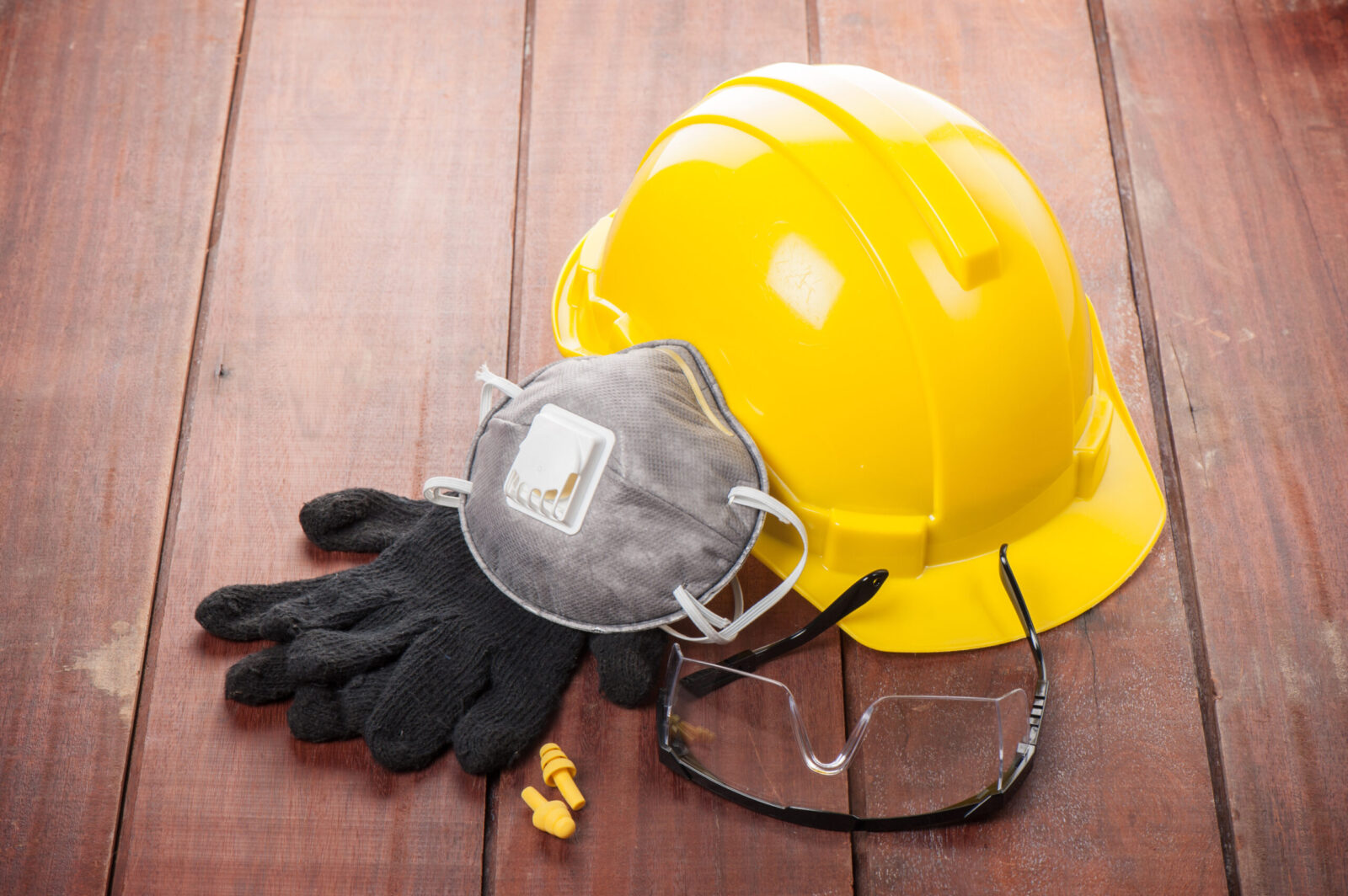
use rubber mats, insulated gloves, eye protection, boots, and head gear (also to be used in conjunction with above measures).
DETERMINING CONTROL MEASURES
Once Risk Assessment is made, continue to determine suitable control measures;
Control measures shall be determined in consultation with supervisors and workers;
Plan control measure in systematic way following hierarchy of control measures;
Control measures shall be in accordance with any relevant to the WHS Act & Regulation, applicable Australian Standards and also company procedures;
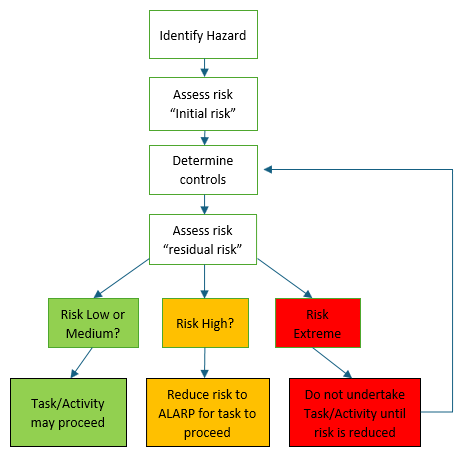
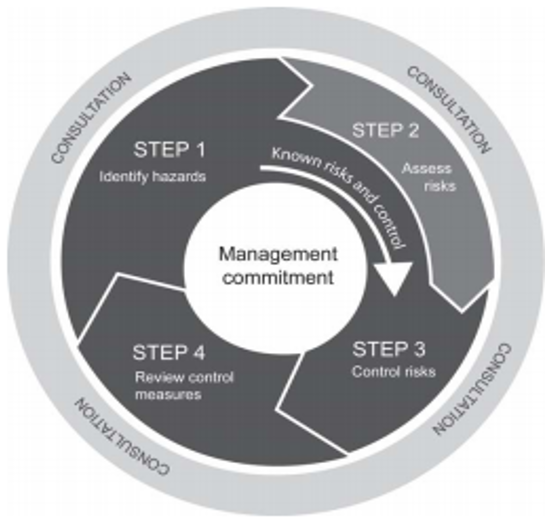
THE PROCESS OF HIRAC
Risk assessment flowchart
FIVE STEPS TO RISK ASSESSMENT
Step 1. Look for the hazards
Step 2. Decide who might be harmed and how
Step 3. Evaluate the risk arising from hazards and decide if existing precaution are adequate or more should be done
Step 4. Record your findings
Step 5. Review your assessment from time to time and revise if necessary
DOCUMENTATION AND COMMUNICATION OF HIRAC
HIRAC documents to be prepared orderly with clear identity (document number);
HIRAC document to be signed by a person who has successfully completed this training;
HIRAC to be understood by all personnel in proportional way (communication and information – Toolbox talks); and
Consultation with workers and/or their representatives
REVIEW OF HIRAC
HIRAC process must be sustainable;
Review of HIRAC periodically will keep HIRAC up to date with site condition;
HIRAC to be prepared prior to commencement of task, at the same time with preparation of work method; and
During commencement of task, conduct HIRAC review periodically, should you find a hazard not identified yet, revise the HIRAC. (SWMS are reviewed periodically).
WHO IS INVOLVED IN MAKING HIRAC
Those involved in making HIRAC are:
WHS personnel/team (Preparation + Advisory)
Management (Legitimacy + Periodic reviews)
Site Manager (Implementation, review and or development/revision).
Workers (Consultation, input and understanding)
EXAMPLE OF THE HIRAC PROCESS
Documents:
ProcedureOHS-SP-11 Emergency preparedness and response
ProceduresOHS-SP-13 Developing safe work method statements
OHS-SP-01 Risk assessment
Form 223 OHS Hazard identification checklist (Project Risk Register)
Form 210 Hazardous substances register
Form 220 Safe Work Method Statement (SWMS)
Safety in Design Register
Form 112 Change proposal & request for direction
Form 105 Toolbox meeting records
Form 224 OHS Risk assessment & control record
Form 225 Plant hazard risk assessment
HEALTH SURVEILLANCE AND EXPOSURE MONITORING
A competent person is only permitted to complete a Health Surveillance and Exposure Monitoring initial assessment
Competency is defined as a person having completed the HIRAC training.
The initial assessment should determine whether any biological, physical and/or chemical atmospheric contaminate exist on site i.e. noise, dust, fumes, asbestos, respirable crystalline silica
The identification, assessment and control is to be completed using Form 223 OHS Hazard identification checklist – project risk register.
Where worker exposure above the workplace exposure standard is likely, an occupational hygienist is to be engaged as per OHS-SP-01 Risk assessment.
HIRAC COMPETENCY
Please complete the Assessment
Your registration completed to undertake this short session will be used to record your training record.
Should you require a copy of this induction, please ask.
Upon successful completion of this training, you will receive a confirmation email.
To acknowledge your completion, please sign the bottom of the questionnaire in the space provided.
Site Induction Acknowledgement
All fields on this form MUST be entered. Please complete accurately as we will send an email to you in receipt of your submission. When you press SEND, it will take about 30 seconds where you will then receive a response on this page that the submission has been received.
When you press SEND, it will take about 30 seconds where you will then receive a response on this page that the submission has been received. You will see the words “Your submission was successful.” – Please wait until you see this prompt before continuing.